Amphitheatre of El Jem (Tunisia) travel guide
Africa Travel Bookings
· 5 min read
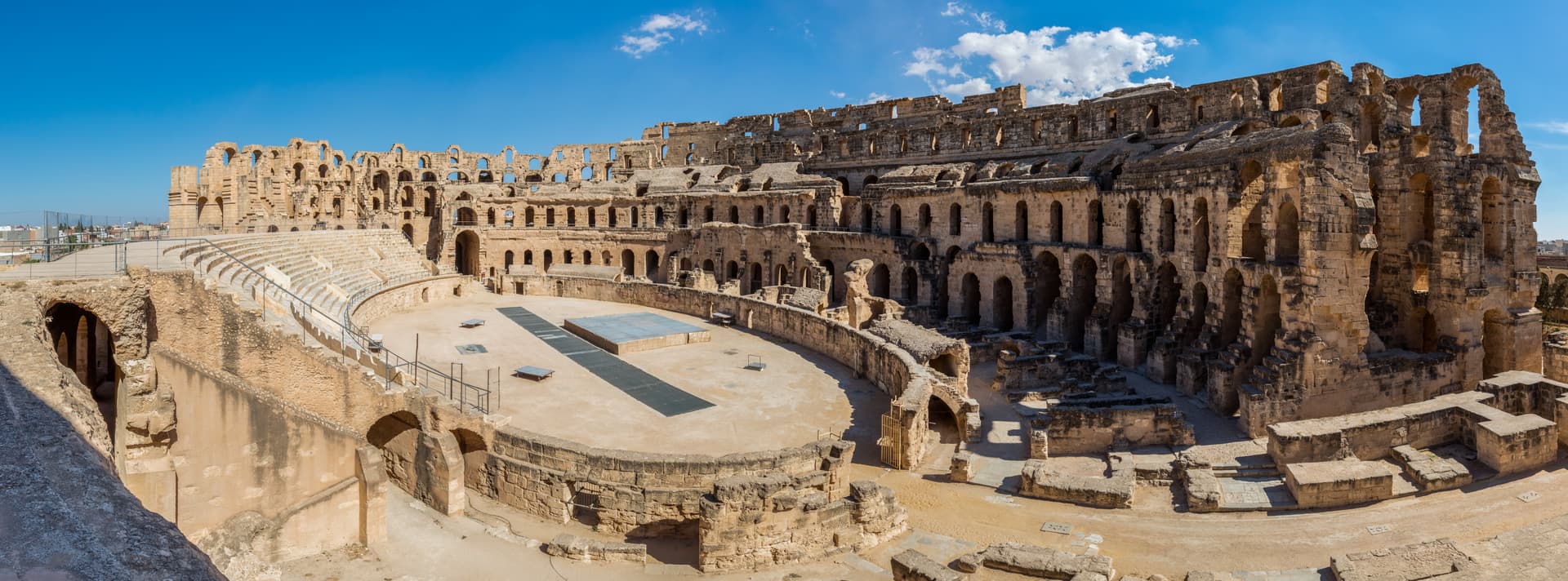
In the flat agricultural landscape of central Tunisia, where the road from Sousse runs south through olive groves and date palms, the Amphitheatre of El Jem appears suddenly and without preamble — a vast oval of honey-coloured stone rising 36 metres above the surrounding town, impossibly large for a place this quiet. This is the third-largest Roman amphitheatre ever built, after the Colosseum in Rome and the Capua arena in Campania, and its state of preservation is extraordinary: much of the outer façade is intact, the triple-tiered arcades still recognisable as the architectural masterwork they were designed to be. A UNESCO World Heritage site since 1979, the amphitheatre of El Jem was built in the third century CE in what was then called Thysdrus, one of the wealthiest cities in Roman Africa and a major centre of olive oil production. Today, El Jem is a small provincial town, and the contrast between its modest streets and this monumental structure is precisely what makes the place so arresting. This guide covers what to see inside the amphitheatre, when to visit, how to reach El Jem and how to plan your itinerary.
Why Visit Amphitheatre of El Jem (Tunisia)
El Jem's amphitheatre is one of those rare monuments that justifies the phrase “better than expected” — and most visitors arrive with high expectations. The sheer scale of the structure is the first impression, and it is a powerful one: the exterior walls are 148 metres long on the major axis and tower above the surrounding streets in a way that makes the entire town feel subordinate to the ruin. Inside, the sense of space and proportion is extraordinary, and the condition of the upper tiers is dramatically better than the Colosseum, which suffered centuries of stone-robbing. The underground galleries are intact, and the arena floor can be walked freely in a way that Rome's monument no longer permits. Unlike Carthage, where the ruins are spread across a wide area and require some imagination to reconstruct, El Jem is a single, overwhelmingly complete structure that needs no imagination at all: you see immediately what it was and what it felt like to be inside it.
Top Attractions & Experiences
The Arena and Seating Tiers
The arena floor is the first destination for most visitors, and it is immediately impressive: an open oval of packed earth measuring 65 metres by 38 metres, ringed by three tiers of stone seating that once held between 30,000 and 35,000 spectators. Much of the middle and upper tiers survive intact, including the original stone seating slabs, the entrance ramps and the corridors between levels. Looking up from the arena floor, the height of the enclosing walls is the defining visual experience of El Jem: unlike smaller amphitheatres where you feel you could step out easily, here the walls close in at an angle that makes escape feel genuinely impossible. Entry to the arena is included in the site ticket and takes around 30 to 40 minutes for a thorough exploration.
Underground Galleries
Beneath the arena floor, the hypogeum — the underground service level — is one of the best-preserved in the Roman world and arguably more evocative than the arena itself. This is where gladiators waited before entering, where wild animals (lions, bears, ostriches, bulls) were held in wooden cages before being hoisted to the arena through trapdoors, and where the mechanical lifting devices that created spectacle were operated. The vaulted corridors are cool, dim and remarkably atmospheric. The original stone-cut channels for drainage, the iron fittings for cage doors and the marks left by equipment on the walls are all visible. A guided tour of the hypogeum, available for $15–25 per person, significantly enriches the experience.
El Jem Archaeological Museum
A five-minute walk from the amphitheatre, the El Jem Archaeological Museum houses one of the finest collections of Roman mosaics in Africa. The mosaics recovered from the villas and bathhouses of ancient Thysdrus are remarkable for their size, detail and condition — panels depicting mythological scenes, hunting imagery, ocean life and the agricultural wealth of the region cover entire floor-sized displays. The museum's layout contextualises El Jem's Roman prosperity: this was a city that could afford floors of extraordinary craftsmanship in private homes, and the evidence is laid out at your feet. Entry to the museum costs around 8 Tunisian dinars and the visit takes 45 to 60 minutes.
Evening Concerts and Cultural Events
The El Jem International Symphony Festival, held annually in late July and August, uses the amphitheatre as its venue for evening concerts that combine classical music with one of the world's most dramatic performance spaces. The acoustics inside the stone oval are naturally good, and the amplified performance under the night sky with the arena walls rising on all sides is an unforgettable experience. Check the festival calendar before booking your visit if timing a special event is a priority. The amphitheatre also hosts occasional theatrical performances and cultural events throughout the year.
Surrounding Ruins and Town Exploration
The town of El Jem itself repays a slow walk. Roman column fragments and stone blocks have been incorporated into modern walls and buildings throughout the old quarter, giving the streets an inadvertent archaeological quality. The market area near the amphitheatre sells local produce, handicrafts and the olive oil that has been the economic backbone of this region since antiquity. South of the amphitheatre, scattered foundations of Roman-era public buildings, bathhouses and residential structures are visible in the fields, giving a broader sense of the city that the arena once served.
Best Time to Visit
El Jem is primarily an outdoor site under the open sky, and the Tunisian central coast climate makes visiting conditions highly weather-dependent.
March to May is the ideal window: the temperatures are comfortable (18°C–26°C), the olive groves and surrounding landscape are green, and the crowds are manageable. Morning visits are particularly pleasant, with the warm stone catching the early light.
September and October offer similar advantages after the summer heat dissipates, with the added benefit of post-season quiet. Hotels in Monastir and Sousse drop their rates noticeably, and the amphitheatre is rarely crowded on weekday mornings.
Best overall: March to May, September to October
Peak season: July to August — hot, busy
Budget travel: November to February — cool, quiet, low prices
Avoid: July to August for those sensitive to heat
Summer is the least comfortable season for the site itself, with daytime temperatures regularly exceeding 35°C and the stone arena becoming extremely hot by mid-morning. If visiting in summer, go early (opening time, around 8am) and leave by noon.
Getting There
The nearest international airports are Monastir Habib Bourguiba International Airport (MIR), approximately 60 kilometres north of El Jem, and Tunis-Carthage International Airport (TUN), around 210 kilometres north. Monastir is served by Tunisair and European charter and low-cost carriers from Germany, France, the UK, Italy and the Netherlands. Tunis is the main hub for scheduled services.
From Monastir or Sousse, El Jem is reachable by taxi in around one hour (approximately 60–80 Tunisian dinars for a private taxi) or by the Tunisian national railway (SNCFT), which stops at El Jem station a few minutes' walk from the amphitheatre. The train is inexpensive — under 5 dinars from Sousse — and reliable. Many visitors combine El Jem with a coastal resort stay in Sousse or Monastir, making a train-based day trip the most practical and atmospheric approach.
From Tunis, the direct train to El Jem takes approximately two and a half hours and costs around 12–15 dinars. The journey passes through Sousse and offers pleasant views of the coastal plain.
Visa & Entry Requirements
Tunisia offers visa-free entry for many Western nationals for up to 90 days. Check the Tunisian Ministry of Foreign Affairs for updated visa rules before travel. Passports should be valid for at least six months after arrival.
Yellow Fever vaccination is required only if arriving from a country with that risk. Most travellers do not need special vaccinations beyond routine immunisations.
Getting Around
El Jem itself is a compact town and the amphitheatre, museum and surrounding ruins are all within easy walking distance of the train station. The amphitheatre stands less than 100 metres from the station exit, and the museum is a five-minute walk from the amphitheatre. No local transport is needed once you arrive in town.
For travel between El Jem and nearby coastal towns, taxis and the SNCFT train are both practical. A hired taxi for a day excursion from Sousse, including waiting time while you visit the site, typically costs 80–120 Tunisian dinars. For those renting a car from a coastal resort, El Jem is on a well-maintained main road with adequate parking near the amphitheatre. Guided day trips from Sousse and Monastir are also available through most coastal tour operators for $40–60 per person, including transport and a guide.
Accommodation Guide
El Jem has limited accommodation, and most visitors stay in nearby coastal towns. This is not a disadvantage — the coastal resorts of Sousse and Monastir are excellent bases and the train connection to El Jem is fast and direct.
Budget (under $80 per night): A handful of simple guesthouses operate in El Jem town itself, offering basic rooms from $25–45 per night. Budget coastal hotels in Sousse provide a better-value and more comfortable alternative at similar prices, with the train connection making El Jem easily reachable.
Mid-range ($80–$250 per night): Mid-range four-star hotels in Monastir and Sousse offer beach access, multiple restaurants and comfortable rooms for $90–$180 per night. These are the most popular choice for visitors using El Jem as part of a broader Tunisian coastal itinerary.
Luxury ($250+ per night): The Sousse and Skanes coastal areas have several premium resort hotels with private beach areas and spa facilities at $250–$400+ per night. For a more boutique experience, a small number of upscale riads in Sousse medina offer beautifully restored traditional accommodation.
Food & Culture
El Jem is a working Tunisian town and the local food reflects that: simple, flavourful and centred on the ingredients this region produces in abundance — olive oil, harissa, fresh vegetables and lamb. Small restaurants near the amphitheatre serve Tunisian lunch staples including couscous merguez, lablabi (a spiced chickpea broth with bread) and fried fish. The market on the main square sells fresh produce, olives and local pastries. Sitting for a slow lunch at one of the cafes near the train station, watching the ordinary life of the town go on against the backdrop of this extraordinary monument, is one of the most satisfying ways to spend time in El Jem.
The local culture is conservative and friendly. Visitors should dress modestly — shoulders and knees covered — particularly when walking through the market area or venturing beyond the immediate tourist zone. Greeting shopkeepers and cafe staff with a Salam alaykum is a simple courtesy that is warmly received. Photography inside the amphitheatre is unrestricted, but ask before photographing local residents.
The broader cultural context of El Jem is the prosperity of Roman North Africa, a period when this region was the wealthiest olive-oil producing territory in the empire and the mosaics of Thysdrus's private homes rivalled anything in Italy for artistry and ambition. The museum makes that context tangible in a way that the amphitheatre alone, for all its drama, cannot.
Budget & Cost Guide
El Jem is one of the most affordable major Roman monuments in the Mediterranean, with low entry fees and cheap transport links.
Budget traveller: ~$55–$80 per day
Mid-range traveller: ~$110–$170 per day
Luxury traveller: $220+ per day
Amphitheatre entry costs approximately 12 Tunisian dinars (around $4). The archaeological museum costs a further 8 dinars. A guided underground gallery tour adds $15–25. A budget day trip from Sousse by train, including entry fees, a local lunch and a guided tour, can be completed for well under $50 total.
Mid-range travellers staying in a coastal resort hotel and adding El Jem as a guided day excursion will spend $110–$170 per day all-in. Luxury travellers in premium coastal resorts will spend $250 and above. The Tunisian dinar (TND) is the local currency; USD and euros are accepted at larger hotels but local cash is essential for train tickets, site entry and restaurants.
Travel Tips & Safety
Visit in the morning. The amphitheatre opens around 8am and the morning light on the stone is spectacular. More importantly, by mid-morning in summer the arena floor becomes extremely hot, and the upper tiers are fully exposed to the sun. A morning visit allows you to explore comfortably and leave before the midday heat sets in.
Bring water and sun protection. There is almost no shade inside the amphitheatre during the day, and the stone surfaces radiate heat. Carry a full water bottle, use SPF 50+ sunscreen and wear a hat.
Book the underground gallery tour. A guided descent into the hypogeum is one of the highlights of the visit and adds context that a solo walk through the arena cannot. Tours are offered at the entrance and typically start every 30 to 45 minutes.
El Jem is very safe for tourists. It is a quiet provincial town with low crime, a friendly population and no particular security concerns. Standard travel precautions are sufficient.
Combine with Mahdia or Sousse. The coastal town of Mahdia, 45 kilometres south of El Jem, has a beautifully preserved medieval medina and excellent beaches. Sousse, 60 kilometres north, has a UNESCO-listed medina and a strong resort infrastructure. Either town makes an ideal base for a multi-day itinerary that includes El Jem.